


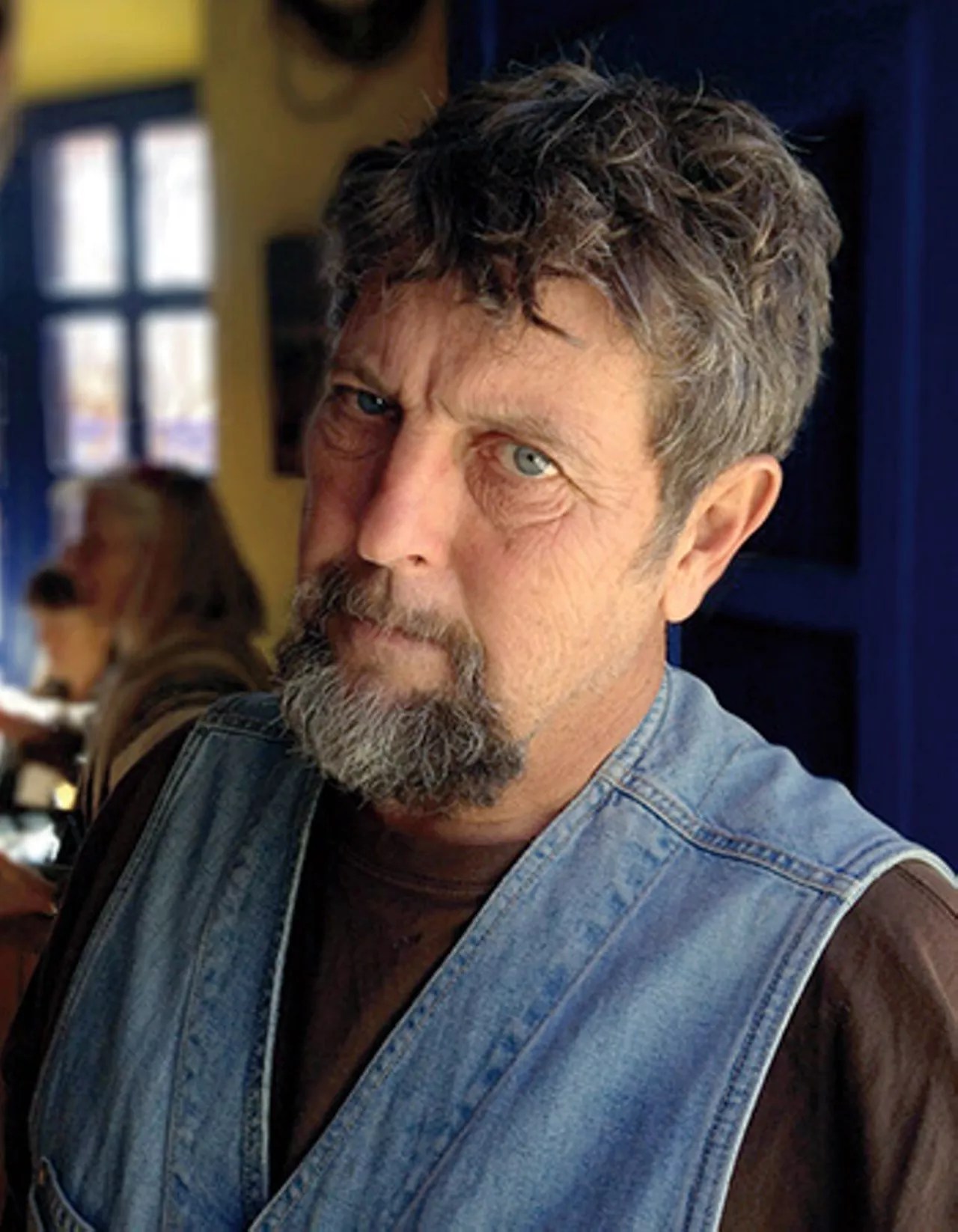
Ethnobotanist, nature writer and sustainable agriculture advocate Gary Nabhan was another Mexican-identified, Anglo border person with a vision for the future. Founder of Native Seeds/SEARCH, Nabhan held the Kellogg Endowed Chair in Food and Water Security for the Borderlands at the University of Arizona Southwest Center. He lived with his wife, a nurse practitioner, on a quiet ranch nestled among the rolling hills outside Patagonia, Arizona. I drove down from Tucson to interview him on a crystal-blue-sky winter morning in February 2018.


Nabhan met me at the highway in his Prius, and I followed him along a winding dirt road, past the Native Seed farm, with a sign that said “Nabhan” in Arabic (he is of Lebanese descent), then up a small hill to a comfortable, light-filled home. The living room overlooked the farm and had a sweeping view of the surrounding mountains. There we talked about the solar wall and other forward-thinking ideas for sustainable border development.
The idea for a solar wall was first proposed by Mexican poet, diplomat and environmental activist Homero Aridjis in response to Trump’s call to build a wall. A friend of Nabhan’s, Aridjis was known for his innovative, problem-solving ideas. He’d founded an organization called the Group of 100 that, among other efforts, helped fight air pollution in Mexico City, create monarch butterfly sanctuaries in Michoacán, and save endangered whales, sea turtles and vaquitas (tiny, nearly extinct porpoises) in the Gulf of California. In a December 2016 Huffington Post article, Aridjis and solar energy advocate James Ramey proposed, instead of a wall, an array of solar collectors on the border that would generate power, provide jobs, and be wildlife friendly and culturally sensitive.
The idea was later picked up in a Wall Street Journal op-ed written by Vasilis Fthenakis, director of the Center for Life Cycle Analysis at Columbia University, and Ken Zweibel, then director of the Solar Institute at George Washington University. They calculated that a string of solar panels built along on the Mexican side could generate two thousand gigawatts of electricity a year, enough to power the entire border region on both sides, while being far less costly and environmentally damaging than a wall.
In April 2017, Nabhan invited Aridjis, Ramey and Fthenakis to Tucson to talk about the proposal. The discussion was held as part of an Earth Week forum at the University of Arizona. The panel explained that the project would not be a continuous wall of solar collectors. “No one involved in this idea wants a wall,” Nabhan said. “We were upset when one of Trump’s five finalists for the wall was 50 feet tall with a solar panel on top.”
“We have to try to find a solution, because the wall exists already,” Aridjis said. “We have to find a solution for the people and the environment and also the economy.”
As Nabhan told me, “We’re talking about collectors in the valleys to create energy because both sides of many border communities are still off the grid. Statistics produced by Homero and his team found this area could produce with solar energy most of what the U.S and Mexico needed. We could create jobs, rebuild communities, and legalize people being there. We could train people to be solar and potentially wind energy technicians, at $25 or $30 dollars an hour. Not just techs, but planners who could offer services in other communities on both sides of the border. We could break the glass ceiling out of menial jobs and end dependence on big power companies.”
Nabhan would also like to see the solar wall address disparities in food security along the border in the form of an “agri-voltaic border cooperative.” As he wrote in an op-ed in the Arizona Daily Star, “Heat sensitive food crops could be grown under the solar photovoltaic arrays, as they are now being done at three Tucson schools and at a demo project at Biosphere 2. Rainwater could be collected off the solar collectors to irrigate crops for use at nearby schools, clinics and homeless shelters in rural border communities.”
Any discussion of a border wall, solar or otherwise, must include the Native peoples who live there, Nabhan noted.
“A fifth of the land along the border belongs to Indigenous communities who also do not want a wall,” he said. “The Tohono O’odham are interested in these projects, since they pay more for their energy than other users, but we don’t make policy for them. None of us are solar missionaries. We respect the tribe’s sovereignty. We will not get the border right if we think this is just a nation-to-nation negotiation.”
Nabhan had a strong faith in what was possible on the border but was not unrealistic about the challenges. He cautioned that the U.S.-Mexico border has the greatest wealth disparity of any border on Earth, with poverty in Mexico resulting in poor diets, education, and health care, as well as a lack of access to clean water and sanitation. The economic disparity had also led to great exploitation of Mexican workers and natural resources by the United States and Canada, as well as the turning of Mexico into a narco state. There were persistent problems on the U.S. side as well, including lack of attention to crucial cross-border issues like water and wastewater flows.
“The entire border has been neglected for a long time,” he said.
A more holistic approach was needed: “Rather than thinking the issue is about simply ‘fixing things at the border,’” Nabhan said, “we need equity on both sides for how we treat people, particularly people who bring us our daily bread. The only way we’ll get over border conflict is by reducing disparity and including the economic and social well- being of people on both sides.”
Two and a half years after this interview, when the pandemic reached the border, the poverty and neglect Nabhan described exacted a huge price. For most of 2020, hospitals on the U.S. side were overwhelmed with people who’d contracted COVID- 19. Many were relatively young, though already in poor health, or worked in low-paying jobs without proper safeguards. Those in Mexico also suffered greatly. Yolanda knew entire families who died, and migrants in Nogales lost a champion on December 18, 2020, when Juan Francisco Loureiro, the founder and director of Casa San Juan Bosco, died of COVID at age 76. (His family said they would keep the shelter going.) Indigenous peoples on both sides were especially hard hit. The Navajo Nation, where poverty was so extreme many people lacked basic utilities, suffered one of the worst outbreaks in the United States. The nation responded with fortitude and self-reliance, however, and helped organize numerous public and private groups to provide water, food, health care, electricity, sanitation, and vaccines to the stricken communities.
As for idealistic notions like the agri-voltaic cooperative, they were put on hold throughout the Trump administration while environmentalists battled his walls (more on that in the epilogue). But the ideas were still viable; Nabhan was working on a demonstration project with Indigenous Seri and Comcaac people near El Desemboque, Sonora. During a visit in July 2020, he and other volunteers found these impoverished villages stricken by COVID- 19 and terrorized by cartel violence in nearby Caborca and Puerto Libertad, but grateful they had not been forgotten by their American friends.
Excerpted with permission from The Beloved Border: Humanity and Hope in a Contested Land, by Miriam Davidson. Published by UA Press. © 2021 by the UA Board of Regents.
This article appears in Aug 26 – Sep 1, 2021.

While I hesitate to burst the balloon of such a Utopian vision, it needs to be said that there are many miles of borderlands where there should NOT be solar panels, which are NOT always and automatically “wildlife friendly”. Large solar arrays can actually do a lot of damage, esp. to endangered species, depending on where they’re sited.
The critique is the same as with the border wall–there are many miles of wildlands along the border that are simply not the place for such industrial activity, no matter what it is, a border wall or solar panels or whatever. For a primary example, a large solar array is definitely not compatible with jaguars or their movement corridors and should not be built in their habitat, which eliminates large areas of rugged terrain along the border.
Thankfully, there are plenty of other places (brownlands, agricultural lands, etc.) where solar can be placed while doing minimal damage to wildlife. A more realistic acknowledgment of the potential damage that can be caused by industrial solar activity would be reassuring when discussing this idea.
Beyond that, rather than double down on the massive damage that’s already been caused by border wall construction and border militarization with even more construction and disturbance, we need to prioritize areas along the border where the wall should be removed as soon as possible and the landscape restored. We can indeed heal some of the egregious damage that’s been inflicted on our beautiful borderlands, but not by piling on large-scale industrial solar arrays.
“The Navajo Nation, where poverty was so extreme many people lacked basic utilities, suffered one of the worst outbreaks in the United States.”
A gem of a non sequitur. The Navajos are hundreds of miles from the border.
Things are so bad in Mexico that the Nogales mayor is crying the blues because Mexicans can’t cross to spend their money here. And I drive a car built in Mexico.
NO ONE wants even SOLAR PANELS ALONG THE ENTIRE BORDER, and Miriam’s interview with me made that clear. Look on http://www.healingthge borderdisorder.org for my many editorials and articles the last two years–New York Times, Az Republic, 30 regional newspapers–that new actions must be about safe passage of endangered wildlife and sacred pilgrims from tribes. YOIU DID NOT BUT ANY BALLOON BECAUSE WE NEVER SAID WHAT YOU ARE SUGGESTING. BUT PEOPLE AND PLANTS AND BATS AND BIRDS MATTER AS MUCH AS THE LARGE HERBIVORES AND PREDATORS THAT NEED TO CROSS THE BORDER LINE ON THE HOOF. And wolves, jaguars, Sonoran pronghorn can navigate between solar panels but cannot leap a 30 foot wall. It is always odd that when we talk about solutions that include elements more than CHARISMATIC MEGAFAUNA, SOME READERS THINK WE DOIN’R CARE ABOUT WILDLIFE. not true. WE CARE ABOUT ALL LIVES, WILD AND OTHERWISE. And no one said anything about “piling on large-scale industrial solar arrays. Not even more than 1 line of panels, in patches, around endangered plants and sacred sites. READ WHAT WE SAID, NOT WHAT YOU PRETEND IS THERE, PLEASE.
Nabhan writes among other gibberish, “READ WHAT WE SAID, NOT WHAT YOU PRETEND IS THERE, PLEASE. “
So I tried to read what he said. One of the many mysteries in his screed is why he can’t even get the URL of his website correct. “www.healingthge borderdisorder.org“
Another is why you would write in all uppercase when what you’re saying makes no sense whatsoever. Seems to me that the smaller the font, the better.
From the story we read, “Nabhan held the Kellogg Endowed Chair in Food and Water Security for the Borderlands at the University of Arizona Southwest Center.”
Somehow I don’t feel very secure.
If you folks who constantly give me “dislikes” would give me “likes” instead, I would be seriously disappointed. Kind of a conundrum for you isn’t it?