


Leaders from five Arizona hospital systems provided distressing news on the continuously worsening presence of COVID-19 in the state at a press briefing yesterday.
For weeks, Arizona has topped the charts for the highest coronavirus infection rate in the nation. Dr. Marjorie Bessel, chief clinical officer of Banner Health, said nearly 1 in 10 Arizonans is currently battling COVID-19.
The state’s total deaths from the virus surpassed 10,000 this week while COVID-19-related hospitalizations and new cases continue to grow.
Bessel said 58% of Arizona’s hospital beds are holding COVID-19 patients, a percentage that’s even higher in its ICUs.
If the virus continues at its current pace, Dr. Alyssa Chapital, the hospital medical director of Mayo Clinic, warned the state will meet the dire point where the needs of the community surpass hospitals’ resources—staff being the most critical.
If hospitals run out of these resources, caregivers would triage care, evaluating each patient on the necessity of their care compared to others. Resources would be allocated to those most in need.
“We have educated our staff about it, but it is our sincere hope that Arizonans can help slow the spread of this virus to avoid a triage situation,” Chapital said.
Dr. Keith Frey, chief medical officer of Dignity Health’s Arizona Division, said one of the reasons the state has yet to reach the dire conditions seen in coronavirus hotspots throughout the nation is because of collaboration among Arizona’s hospitals.
Frey lauded the state for being the first to set up a surgeline that allows hospitals to transfer patients based on their necessary level of care so no one facility becomes overwhelmed.
He said the state’s hospitals agreed no one hospital would activate triage based on the Arizona Crisis Standards of Care plan unless they all reached the point of critical resource shortage needed to do so.
“This collaboration and commitment along with our respective systems’ efforts to scale up to meet the demand for healthcare services in our community are the reasons that we continue to be open and accessible for all those in need of care,” Frey said.
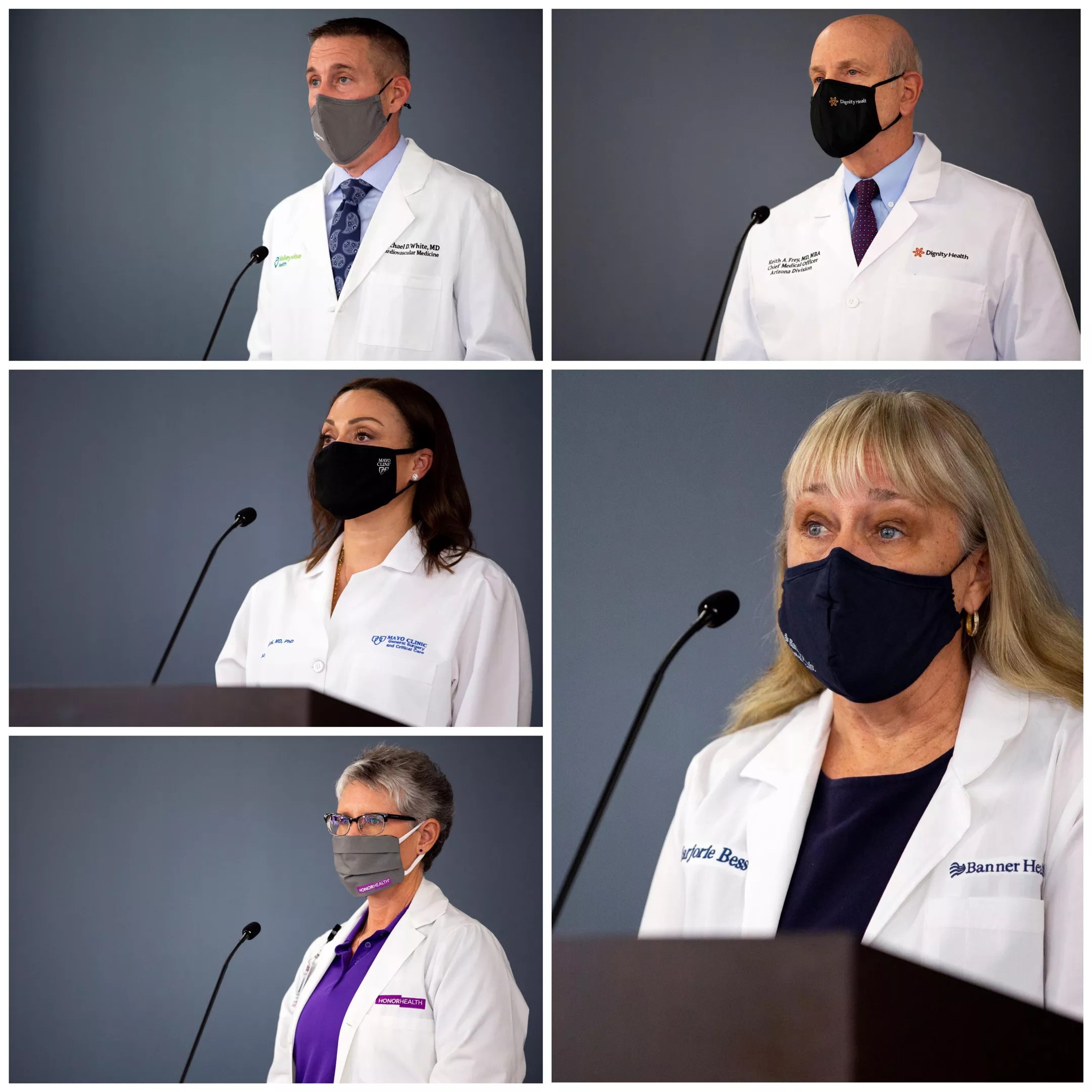
Dr. Stephanie Jackson, senior vice president and chief clinical value officer of HonorHealth, asked for patience as the state transitions between groups who qualify for the vaccine. When it does become available to a set population, she encourages everyone who can get a vaccine to do so.
However, COVID-19 mitigation standards don’t stop after vaccination.
“Even after getting vaccinated, it will be necessary to continue with the core COVID-19 safety precautions, including wearing a mask, social distancing and washing your hands,” Jackson said. “These precautions will be necessary for the foreseeable future until we have more information about how long vaccine protection lasts and as more people become protected through the vaccination over time.”
Dr. Michael White, executive vice president and chief clinical officer of Valleywise Health, called for more mitigation policies and enforcement to slow the spread, including a statewide mask mandate, a curfew, a ban on large gatherings and a suspension of indoor dining.
He also called on Arizona’s citizens to do their part by shrinking their circle of interactions to only those in their immediate household, frequently wearing masks and avoiding gatherings with unmasked individuals.
“Many individuals that we see within our communities may have COVID-19 disease and not know it,” White said. “You may have this virus and not have symptoms, and when you bring individuals outside of those that you live with in close proximity, not wear your mask, not maintain that social distancing, you’re increasing the risk that you may transmit this, even though you don’t have symptoms, someone you may give the virus to may have underlying medical conditions may be completely normal, but their body’s response to this infection may ultimately wind them up needing medical care, or in one of our intensive care units.”
This article appears in Jan 14-20, 2021.

Chicago and NY politicians are now calling for restaurants and bars to repoen. That is, if there are any left.
Absolutely shameful. This is all due to people not wearing masks, Ducey not allowing the mayors/counties to do more like shut indoor dining, and selfish pricks who couldn’t just stay home for Thanksgiving, Christmas and New Years.
The collapse of the health care system is on you, you selfish, anti-community pieces of s***.
Again, I am sharing more specific information as to the presence of COVID within the walls and fence lines of The Arizona State Hospital (ASH), and in all other such state managed long term care facilities (the elderly, et al). It is increasingly clear that access to the COVID vaccine is limited to an arguably elite section of the public health care spectrum, and this is especially impacting the health and welfare of all poorer or otherwise disenfranchised communities in the USA and beyond. The patient community at ASH is very much a disenfranchised aspect of AZ’s public health spectra. However, the conditions in settings such as ASH also qualify as likely super spreader sites. The following COVID information in this context has been provided by the following resources:
1) National Association of State Mental Health Program Directors
2) American Psychological Association
3) Judge David L. Bazelon Center for Mental Health Law
4) Mental Health America
5) National Alliance on Mental Illness
“Middletown, Connecticut. January 13, 2021. The case of Wilkes v. Lamont was filed in response to Covid deaths and unsafe conditions in two of Connecticuts state psychiatric hospitals, Connecticut Valley Hospital and Whiting Forensic Hospital. In the spring COVID surge, five patients died and scores of patients and staff were infected. Accordingly, to implement the CDCs recommendations, state authorities making vaccine allocation decisions should:
1.Include psychiatric inpatients whose hospital stay is likely to be weeks or months in the first group to receive the vaccine (phase 1a).
2.Give short-term psychiatric inpatients the same priority as other hospital inpatients.
3.Require that hospital discharge plans provide for the administration of a second dose of the vaccine.”
Any of you interested in learning more about the national current with respect to this effort as means to ensure legitimate COVID responses of all US states at this crucial time, please see:
https://www.samhsa.gov/sites/default/files/considerations-care-treatment-mental-substance-use-disorders-covid19.pdf
I wish to express my sincere thanks to Nicole Ludden for your diligent reporting of all elements in the COVID crisis in Arizona. Paolo Jack Reed. Author: “PJ Reed. The Arizona State Hospital and Patient Abuse.”