


You can vote for both, but please don’t … Judging at the speed of business … And the man just loved craps.
The future of voting in Arizona could be decided at the ballot box this year as two dueling ballot measures that are attempting to qualify for the ballot offer visions of voting that couldn’t be more different.
And then there’s whatever the Arizona Legislature will do, and the options range from nearly 100 election-related bills with hosts of smaller changes to straight-up decertifying an election (as a resolution filed by Arizona Rep. and not-a-lawyer Mark Finchem wants to do).
The Arizonans for Fair Elections measure, filed yesterday and backed by a coalition of local left-leaning groups, attacks a spate of laws from the past few years that limited voting access in Arizona and seeks to protect election results from potential overturning.
The measure has four goals, according to Joel Edman, the co-executive director for communications at ADRC Action: protecting the right to vote and access to voting, protecting election results from partisan meddling, protecting the public’s right to pass ballot measures and limiting the power of lobbyists and outside influence.
“Some of these are trying to address long-standing issues and build a democracy where we all have a voice, and some are more targeted to rolling back restrictions we’ve seen in the past few years,” Edman said.
Some of the elements of the measure will cost money, like increased Clean Elections funding for candidates who don’t accept money from outside sources and some funding for elections infrastructure. The costs will be covered by increasing the lobbyist registration fee from $25 to $50, increasing the minimum income tax for large businesses from $50 to $150 and restoring a $5 tax donation program for Clean Elections.
Another measure, dubbed the Easier to Vote, Harder to Cheat Act, wants to make it so Arizona races are called earlier, though the measure would do that by limiting early voting. It would cut the window for early ballots and make it so you couldn’t drop them off on Election Day; you would instead have to complete a ballot the regular way at the polls. It would also make Election Day an official state holiday.
“What we’re really trying to do here — and I will acknowledge the initiative doesn’t come right out here and say this — what we’re really trying to do is put the counties in a position where 99% of the votes cast in any particular general election are counted by the time the sun comes up on the Wednesday after the election,” Lee Miller, a former assistant secretary of state, told the Arizona Mirror’s Jeremy Duda.
We’re sure the most outlandish bills in the Legislature this session won’t make it into law, like the one that got assigned to 12 committees. (And any of the eventual elections laws that get signed in could then become subjects of referendum, or “citizen veto” campaigns.) But that’s usually how it works: Someone in the majority party throws out an egregious bill, it gets walked back and the compromise bill looks tame in comparison. Maybe the threat of losing the Super Bowl — again — will play a role in what happens this session.
Backers of the two measures will need to collect more than 237,000 signatures to qualify for the ballot. That’ll cost millions of dollars and armies of paid circulators and volunteers, and that’s before they have to convince voters their plan is the best way forward.
Politicians like to say that the future of democracy is on the ballot. This year, it will literally be true.
While you’re at it, support local journalism like your ability to read local journalism in the future depends on it.
 |
Can’t you speed up just a little?: A Maricopa County judge warned lawmakers that he’s going to take his sweet time deciding whether Proposition 208, the Invest in Education initiative, is constitutional. The problem is that Republican lawmakers have been unwilling to lift the looming education spending cap to allow schools to spend the 16% of their budgets that the cap makes untouchable until the courts rule on Prop 208 because lifting the cap would undercut their legal argument. The cap must be lifted by March 1 to avoid financial ruin for the public school system, the Republic’s Mary Jo Pitzl reports. But Maricopa County Superior Court Judge John Hannah legally has until March 10 to decide, and he told lawmakers who urged him to hurry up that that ain’t happening.
“I get the decision out when I get it out,” he said, per Pitzl. “I hope the policymakers can figure out how to work around what I’m doing. My point is to give the case due consideration and decide it as best I can.”
It’s none of your business if she shows up to work or not: Maricopa County Attorney Allister Adel went on KJZZ’s The Show and KTAR yesterday to defend herself against a backdrop of new allegations from former Republican County Attorney Rick Romley, Adel’s friend and mentor. Romley told the Republic that she is “not doing the job” and is making life harder for her employees who are running the office in her absence. Adel shot back that she knows who in the office is tattling on her and that she’s sad there’s so much “conjecture and hearsay” about her ability to do the job while working on her addiction problems, and accused people of “politicizing” her “personal journey.”
“It’s perfectly legal” is not usually a great defense: Arizona Attorney General Mark Brnovich said Gov. Doug Ducey can use his war powers to put the Arizona National Guard on the border to fight drugs and gangs if he wants. Brnovich released the legal opinion Monday in response to a request from Arizona Rep. Jake Hoffman, who was one of the legislators calling for Ducey to deploy the Guard. Some Guard members are already at the border, but on a support mission, not to defend the state.
May the most connected contractor win: Arizona is setting up a new mental health crisis hotline, but one of the local nonprofits that wants to apply for the contract is flagging the process as unfairly slanted to favor an out-of-state competitor, the Republic’s Stephanie Innes writes.
There’s that bipartisanship they’re always touting: Democratic U.S. Sens. Kyrsten Sinema and Mark Kelly teamed up with Republican Rep. David Schweikert (and a whole bunch of non-Arizona lawmakers) to push legislation to extend telehealth services for Medicare patients, which were originally supposed to expire in 2023, the Republic’s Cami Parrish notes.
We feel you: Several longtime lawmakers have caught a bad case of the Great Resignation. It seems Democratic Sen. Rebecca Rios and Democratic Rep. Robert Meza, who combined have spent nearly 40 years at the Capitol, are running for much cushier gigs as justices of the peace.
ICYMI, we love the border campaign ad genre: Gubernatorial candidate Karrin Taylor Robson’s border ad, in which she calmly speaks her lines as (allegedly) undocumented immigrants pass close by her at the U.S.-Mexico border, sent up red flags at FS1, a FOX Sports-owned cable channel. The channel said it will no longer air her ad unless she provides an affidavit that the video was actually filmed at the border, as well as proof of citizenship for everyone shown, Taylor Robson tweeted. She called the request censorship and “nuts,” and her campaign flatly denied that there was any creative editing of the video.
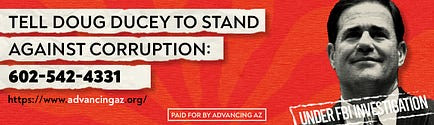
Don’t call him while driving: Accountable Arizona is pumping six figures into digital ads and billboards around the Valley declaring Gov. Doug Ducey is under FBI investigation (as we’ve noted, that really seems like a stretch) and urging Arizonans to call him and tell him to stand against corruption. Why? Because there’s still time for him to jump into the U.S. Senate race and this serves as a preview of the hits to come if he does.
 |
A blast from the past: This NPR story about the situation in Ukraine, a topic where we are out of our depth as local Arizona journalists, features Kurt Volker, who you may remember from the time he stepped down as executive director of the McCain Institute for International Leadership at Arizona State University and as special envoy to Ukraine under Trump (which we remember because a college student at the State Press, Andrew Howard, broke the international news). Anyway, Volker was in Kyiv at the time NPR talked to him recently, where he “happened to be for the opening of American University Kyiv, a partnership with Arizona State University.”
A blast from the even past-er past: A new book from New York Times reporter Jeremy W. Peters reveals how the late U.S. Sen. John McCain selected Sarah Palin as his running mate. His advisers told him it was a risk not just to his electoral prospects, but to his reputation. McCain was undeterred.
“McCain, an avid craps player, balled up his fist and blew on it, then shook it like he was about to roll a pair of dice. ‘F—- it,’ he said. ‘Let’s do it.’”
That damn Census: The Latino community’s growing influence in state politics could be disrupted by a Census that didn’t fully count them and a redistricting process where Latinos fared poorly, James E. Garcia writes for the Arizona Mirror.
Enjoy the winter while it lasts: It might be Phoenix sweater weather right now, but cities are preparing for a scorching summer yet again. The City of Phoenix expects to finalize a citywide plan for heat response that focuses on the homeless population, including more shelter beds and cooling stations, KJZZ’s Christina Estes reports.
A tiny version of a universal basic income: One thousand low-income families in Phoenix will get $1,000 per month for the next year, with the first set of loaded debit cards arriving this week, the Phoenix New Times reports. The city chose the 1,000 families in a lottery process, and the program is paid for with federal pandemic relief money.
 |
Today we have a double feature of two bills that Republican Speaker of the Arizona House Rusty Bowers is backing that have Democratic support.
House Bill 2650 would create a new division within the Department of Public Safety to investigate police use-of-force incidents at other departments and require every police agency to utilize either the new bureau, a regional law enforcement task force or an outside law enforcement agency to investigate any critical force incident in Arizona. Democrats were quick to compliment the bill while noting it was their idea first.
And HB2802 would create a statewide ban on discriminating against gay and transgender people in housing, employment and public accommodations. Several Arizona cities have similar protections in place, but Arizona has no statewide law — in part because Bowers has opposed it in the past, the Arizona Capitol Times’ Nathan Brown writes. The bill also has the backing of the Church of Jesus Christ of Latter-day Saints, of which Bowers is a member. Democratic Rep. Amish Shah sponsored the bill and Bowers is a co-sponsor.
 |
Before we get into this further, keep in mind that Social Security numbers have nine digits.
Now, check out this classic Gawker story about how they requested U.S. Sen. Kyrsten Sinema’s divorce records from 1999 from Maricopa County, which included unredacted personal information like her Social Security number and bank info. The clerk’s office told the outlet that they only needed to redact such information if they had a court order.
You may have noticed a number near the top of the Gawker story. It is not, in fact, a Social Security number, despite the immediate Twitter outrage. It is the phone number that rapper Soulja Boy sings in the 2008 hit, “Kiss Me Thru the Phone.” Gawker didn’t publish the personal information “out of respect for Sinema and because we like our jobs.”
“You can do a lot with a social security number,” Gawker reporter Tarpley Hitt writes. “Unfortunately, if the number in question isn’t yours, most of what you can do with it is a felony.”
This article appears in Feb 3-9, 2022.
This is a Tucson newspaper in digital form. It perpetually screams about Republicans when it should be performing non-stop self-examination.
I am looking at a graph from the Saint Louis Federal Reserve data system of jobs in Tucson.
From 1990 till 2007, that graph was increasing at the rate of 6,000 jobs per year. Since 2007? Zero jobs.
How does a large city, Tucson, with a population of 550,000 not create any jobs for a decade and a half??? It takes an unusual level of incompetence. Extreme incompetence.
Tucson exists in a state, Arizona, which has led the nation in creating jobs during that same time period. Tucson exists in a nation which has led the world in creating jobs. If Tucson had just matched the pace of the nation, it would have created 18,000 jobs instead of zero. If Tucson had matched the pace of Arizona, it would have created 25,000 jobs. If Tucson had matched the pace of Chandler, my home town, it would have created
Instead, zero…
Don’t blame the police for Tucson setting an all-time record for homicides in 2021, blame the city council, blame the University of Arizona, blame the media, blame http://tucsonweekly.com.
This combined group of proselytizers has created a parasitic city culture, a looting culture both in the local school district and in city government. A parasitic culture in which all money is divided amongst the looters. None goes to the benefit of the citizens.
Citizen excellence is not tracked, complaints are not resolved, poor neighborhoods are completely ignored. Streets are not maintained.
How does this culture sustain and enable itself? Within city government, they do reclassification of jobs, when they do this, it enables them to dip into the till and put money that should go to the benefit of citizens into their own pockets. They do promotions which enable them to take money out of the till, money which should go to the benefit of the citizens going into their own pockets. When people retire, they assume that that salary is theirs to divide amongst themselves, taking money that should be evaluated for improving efficiency and effectiveness out of that stream.
All this happens without the city council ever putting forth agenda items to get it under control, to force these raids into the budgeting process in which a share of that money would have to be returned to the citizens or go to providing better services.
All governments do these things. Tucson does it more when it needs to do it a lot less.
You see the results most vividly in Tucson’s streets. 380,000 miles of cracks, crevasses and potholes in 2,500 miles of streets. You see it in citizen stressed and expressing that stress in all-time record murders in 2021.
No rational business would ever move to Tucson.
LOL. Liberals are always screaming it’s Republicans fault but it’s a liberal mayor and a liberal city council in Tucson. Tucson has seen record growth from the West Coast invading the city, federal sanctioned refugees with no work skills invade the city, record homelessness, record increase in cost of living and rent and what does it do to help? Scold a bunch of seasonal students about the antics that unsupervised college kids do while catering to the feelings of a poorly placed mosque next door. Oh I am going to vote like my ability to vote depends on it. Like a lot of independents, disillusioned democrats and republicans are going to do.
Why do all the crackpot politicians insist on wearing cowboy hats? is it to hide the points on the tops of their heads?
I see Jhumpty is in fantasyland again.
Here’s the real numbers for just the last several months.
https://www.deptofnumbers.com/employment/a…
https://www.bls.gov/eag/eag.az_tucson_msa.…
“Here’s the real numbers for just the last several months.”
When you look at a few months to deceive people as to the nature of things, that’s fantasy land. Not when you look at 30 years of data. When you go out into the poor neighborhoods south of 22nd street and see more cracks than pavement in many streets.
30 years of behavior has all come home to roost. Citizen excellence surveys abandoned because the feedback is too brutal.