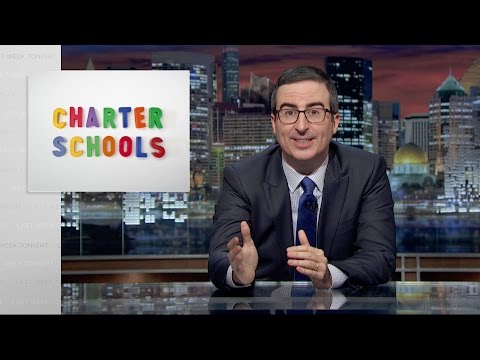
John Oliver and his staff clearly did their charter school homework. On Last Week Tonight last Sunday, Oliver discussed problems with the lack of vetting of people who open charters and the lack of oversight once schools are open. He shows people plagiarizing their charter applications, others using charters as their personal ATMs, and schools closing without notice. It’s not meant to be a takedown of charters. It’s more of a spot-on harangue about the need to tighten charter school rules and regulations to keep the bad actors out.
19 replies on “What John Oliver Said About Charter Schools”
Why not fix the public schools first so the parents have something to fall back on? You have no intention of fixing public schools do you?
Yep, regulation of public schools has been so successful, huh? Yeah, let’s put all those regulations on charters, too.
Public Ed Is So Broken… You don’t fix something that is supposedly broken by replacing it with something even more broken and robs the public. I also contend that public education’s funds were systematically and purposely cut for decades to make them broken. Tom Horne said and this is not a direct quote but I did hear him say it…. that he would see TUSD closed in his lifetime. He was upset with the Mexican American Studies program.
We can always fix schools as everything in life needs to continually be improved. However the Koch brothers’ agenda is alive and well which is to close all public education or at the very least separate children of color and/or are poor from those of affluence. White entitlement at its finest. You, ‘Broken’ are supporting crime by supporting what charter schools are doing. In addition there is no documentation that charter schools do any better and in many cases do worse than regular public schools when demographics are taken into account.
Those who claim our public schools are broken should try funding it for a change. Here in Arizona we have methodically and deliberately de-funded our public schools in favor of tax cuts for the wealthy. Now we complain that the schools are broken and instead turn to for profit unaccountable charters.
” In addition there is no documentation that charter schools do any better and in many cases do worse than regular public schools.”
Sounds like something I would have said years ago when I was a member of the NEA. I don’t know where you’re getting this “no documentation” info from, but it’s bullcrap.
School choice has been extraordinarily beneficial in Arizona. In 1992, the start of school choice, juveniles committed 70 murders in Arizona. In 2012, despite a doubling of the juvenile population and a tripling of the at risk population, murders by juveniles had dropped to 7.
In 2015, Arizona African Americans ranked number one in the nation in 8th grade math scores. Hispanic 8th graders ranked 11th, up from 35th in 2011 and Arizona white students ranked 6th.
Arizona also did well in reading with Blacks, Whites and Hispanics ranking 14th, 7th and 29th.
In the 2015 nationwide Gallup Poll 24% of parents rated their child’s school quality an “A”, the second lowest number in 47 years of measurement. All of our “A” rated districts were rated by their parents 60s or higher with the Chandler Unified the grand champion at 75%.
These measures are the science of school quality.
2012 is the most recent date of FBI juvenile statistics. The school rankings are from NAEP, the gold standard of educational measurement.
Thanks j. I found more of those facts when I looked. We are sure led to believe that all they needed was more money. There is something inherently flawed in the delivery process of public education.
In other posts, Huppenthal has seemed to understand that test scores and parent satisfaction surveys do not measure school quality. Here he is citing rankings based on test scores and parent satisfaction surveys to try to prove that the Arizona educational system has improved since the introduction of charters. Are there multiple people, with mutually inconsistent opinions, posting under Huppenthal’s name, or is the real Huppenthal just being inconsistent?
Also: please note that there has been no plausible argument in support of a viable “causation” relationship between the introduction of charter schools and a reduction of murders committed by juveniles. There are any number of factors that could have played into such a reduction, as anyone with a decent background in social science (as opposed to engineering and business administration) knows.
Being able to act constructively in a position like State Superintendent of Instruction properly requires a sound knowledge base in the social sciences and the field of education. The fact that the majority of voters in this state do not seem to grasp this is a good argument for making the role an appointed one, rather than an elected one. The fact that the changes made to the public education system here in recent years have left us with schools where we cannot fill our teaching positions with fully qualified, professional teachers is another argument for taking the ability to fill State Superintendent of Instruction out of the hands of voters.
As for those who like to blame the problems in public schools solely on funding cuts, they are only partially right. If they would like to develop a more well-rounded understanding of what is really happening in the world around them (as opposed to what is happening in the stories they tell and re-tell themselves and others), they should start forcing themselves to attend every TUSD Board meeting. There, if they pay attention, they will soon note that gravely malfunctioning governance and administration — related to but not necessarily caused by insufficient funding — are a big part of the picture in the largest public school district in Southern Arizona.
It has been previously noted in these comment streams that the entirely preventable governance and administrative problems in a public school district serving tens of thousands students is partly the state’s fault, not just because of its ill-advised funding cuts, because also because of its negligent oversight and lax enforcement of laws on the books that are there to keep public districts functioning properly.
The poster looked to me like jhuppent. I wasn’t sure who/what that was. Are you sure that Mr Huppenthal posts here? But I did find accurate links to statements made.
Someone who seems to be wanting to convey the impression that he is Huppenthal and who regularly introduces Huppenthal-style talking points and defends Huppenthal’s agenda in office has been commenting on Safier’s blog for a while now, and there have been interesting exchanges in the comment streams with this individual (or these individuals? — you never know with anonymous comment streams where the user chooses the screen name). In that Safier was one of those somehow involved in the breaking of the stories on Huppenthal’s role as an anonymous online commenter and in the lead-up to Huppenthal no longer serving as State Superintendent of Public Instruction, it would make some sense for Huppenthal to post here under his name now, but who knows.
As for the idea that “There is something inherently flawed in the delivery process of public education,” there are certainly serious problems in some public school systems in the US — especially in poor urban districts like TUSD, which properly form a category unto themselves — but a thorough study of public education systems in other states in the US and in other countries would be needed before any conclusions could be drawn about the extremely broad and diverse category “public education.” There are better and worse ways of managing publicly funded delivery of universal K-12 instruction. Arizona, for various reasons including both ill-advised draconian funding cuts at the state level and some state-enabled egregious examples of gross mismanagement at the district level, falls into the “worse” category.
Public education is not broken and has never been. That’s simply the mindless blather of those who should devote their time to addressing our broken society and political system.
Whether or not charter schools are good (some are, most aren’t), Oliver is discussing the cancerous influence of for-profit ‘public’ charters and the vultures profiting from them.
Spoken like a true teacher. World and federal governments have overloaded the public schools with unnecessary crap and nobody wants to admit they just can’t seem to teach the basics. That’s exactly why thinking parents have left. I appreciate choice in education for all. At this point what do you have to lose?
To: Clearer understanding
You comment points out the paradox of measurement. If you are running a high quality education system, test scores will go up. Yet, at a classroom, school and district level, focusing on test scores does not produce a high quality system. After 40 years of getting the system to become ever more and more focused on test scores the bankruptcy of that approach couldn’t be clearer.
Learning is all about motivation. The unmotivated brain literally can not learn. And, motivation is all about emotion. Measuring motivation or derivatives of motivation is the future of education. That is why I advocate measuring parent, teacher and student perception of excellence.
Gallup has developed an amazing “Hope Engagement and Well Being” question set. Teach Like a Champion also has an amazing question set.
When I was on a school board, I chose a more laser like approach – one question. “Please rate the quality of education your child is receiving.” for parents with a scale starting at “Outstanding”. Nationwide, about 9% of parents rate the quality of education their child is receiving as outstanding, a higher standard than excellence. People get very uncomfortable when the quality of what they are doing is rated at 9% and as a result of that discomfort, they begin to change i..e Improve.
Most school districts interpret their parent satisfaction surveys in a way that validates current practices (TUSD) and as a result, produce no change. The current percentage of parents rating their child’s school excellent nationwide is 24%, 1 point away from the lowest level in 47 years.
Motivation is important. Student and parent engagement are important.
Employing professional teachers who have an ACCURATE understanding of how learning works and what the best methods are in each of the subject areas is also critically important, and, as I have pointed out before, when you pay professionals with college degrees (and many of them with master’s degrees) in their fields the paltry “salaries” they are paid in this state, you will not be able to retain the kind of professional educators that can most benefit students in Arizona classrooms.
Decision makers in the field of education in this state seem to believe it is possible to go back to how the profession was managed before educated women had other professional opportunities. These days, women are not constrained to “teacher, nurse, or secretary.” The unavailability of other options (and the fact that most teachers were women whose husbands were the main wage earners in their families) is what kept salaries in the profession depressed for so long. These days, if you want to retain the most qualified people in the profession, you have to compete with salaries in medicine, law, business.
A friends knows of former classmates at the University of Vermont College of Education, where she got her teaching credentials, who after a couple of decades in the teaching profession are making over $100K per year. Teaching in Tucson, this woman is making $40-something K with the same number of years of experience.
If you’re so interested in free market models perhaps you should do a little more research in the area of human resources and human capital. Paying teachers as little as we do is destroying our education system in this state.
No it isn’t. You sound just like Washington insiders opposing Donald Trump to preserve their income. Had enough, and we have nothing more to lose. Change is coming.
If the kind of change Trump supporters are looking for does come, I suspect they will find that they have plenty more to lose. But, for the time being, it seems to feel good to many people in this country to make emphatic, “in your face” statements which promote the idea that a crass, unstable real estate developer will magically be able to solve all our problems as a nation. It is deeply troubling.
College educated, credentialed teachers who are choosing not to work in their profession because it does not pay a professional wage comparable to what they can earn in other professions requiring college degrees – and there are thousands like this in the state now, more than enough to fill all the vacant positions currently filled by insufficiently qualified substitutes — are not like Washington insiders who don’t want to give up their unreasonably inflated salaries. They are people who could be doing the next generation a valuable and much-needed service, but who are unable or unwilling, quite reasonably, to provide that service at far below what is reasonable compensation for work requiring that much up-front investment in the education required to qualify.
In a context where the cost of college tuition has risen more than 300% in the last 30 years, education professionals, like other members of the college educated middle class, have to be prepared to pay back their own educational loans and to pay a small fortune to educate their own children.
Because there are so many people in this state who don’t think their own children are worth the investment it actually takes to maintain fully qualified professionals in K-12 schools, many of our Arizona teaching professionals have to work in other fields in order to be able to afford to fully educate their own children. A sad irony.
Money. Money. Money. You have got to adjust the message because people catch on to that too fast. Why not call it something else. Like “let’s INVEST in our children.”
Oh wait, they’re not our children are they? AZ teaching professional choose not to send their kids to public schools so they earn enough to pay for it. But let’s continue to keep the poor down and leave them stuck in declining schools with less than the best teachers. You’re the one that said they are working in other fields.
Being paid with “taxpayer money” should mean that charter schools will open their books for taxpayer review and approval. But it apparently does not make them flinch at all. The examples mentioned by John Oliver for administrative malfeasance, deceitful “EMO” operations and hollow online charters are not fictitious. And as such, these operations are not just unethical but they are truly repulsive and nauseating abuses of a public trust. All charter school operations should open their books and show how they work and who gets what. Anyone who runs a clean and effective charter should just do it.
Charter schools can fill the gaps for lots of kids that just fall through the public schools. 2 of my kids thrived in the public school. Self motivated and have went on to college with academic scholarships.
The other 2 did ok in elementary grades, middle school and high school worse. Both have developmental disabilities that the schools did not or could not understand. Too “smart” for special ed, don’t fit in with regular classes. One graduated from a public school “alternative HS ” which actually understood him. The other one is in a charter school, struggling, but they are very supportive.
One school system does not fit all kids!!!!!!!!


Why not fix the public schools first so the parents have something to fall back on? You have no intention of fixing public schools do you?
Yep, regulation of public schools has been so successful, huh? Yeah, let’s put all those regulations on charters, too.
Public Ed Is So Broken… You don’t fix something that is supposedly broken by replacing it with something even more broken and robs the public. I also contend that public education’s funds were systematically and purposely cut for decades to make them broken. Tom Horne said and this is not a direct quote but I did hear him say it…. that he would see TUSD closed in his lifetime. He was upset with the Mexican American Studies program.
We can always fix schools as everything in life needs to continually be improved. However the Koch brothers’ agenda is alive and well which is to close all public education or at the very least separate children of color and/or are poor from those of affluence. White entitlement at its finest. You, ‘Broken’ are supporting crime by supporting what charter schools are doing. In addition there is no documentation that charter schools do any better and in many cases do worse than regular public schools when demographics are taken into account.
Those who claim our public schools are broken should try funding it for a change. Here in Arizona we have methodically and deliberately de-funded our public schools in favor of tax cuts for the wealthy. Now we complain that the schools are broken and instead turn to for profit unaccountable charters.
” In addition there is no documentation that charter schools do any better and in many cases do worse than regular public schools.”
Sounds like something I would have said years ago when I was a member of the NEA. I don’t know where you’re getting this “no documentation” info from, but it’s bullcrap.
School choice has been extraordinarily beneficial in Arizona. In 1992, the start of school choice, juveniles committed 70 murders in Arizona. In 2012, despite a doubling of the juvenile population and a tripling of the at risk population, murders by juveniles had dropped to 7.
In 2015, Arizona African Americans ranked number one in the nation in 8th grade math scores. Hispanic 8th graders ranked 11th, up from 35th in 2011 and Arizona white students ranked 6th.
Arizona also did well in reading with Blacks, Whites and Hispanics ranking 14th, 7th and 29th.
In the 2015 nationwide Gallup Poll 24% of parents rated their child’s school quality an “A”, the second lowest number in 47 years of measurement. All of our “A” rated districts were rated by their parents 60s or higher with the Chandler Unified the grand champion at 75%.
These measures are the science of school quality.
2012 is the most recent date of FBI juvenile statistics. The school rankings are from NAEP, the gold standard of educational measurement.
Thanks j. I found more of those facts when I looked. We are sure led to believe that all they needed was more money. There is something inherently flawed in the delivery process of public education.
http://www.eastvalleytribune.com/opinion/article_44986318-10c3-11e6-85f9-830cdaf38ade.html
In other posts, Huppenthal has seemed to understand that test scores and parent satisfaction surveys do not measure school quality. Here he is citing rankings based on test scores and parent satisfaction surveys to try to prove that the Arizona educational system has improved since the introduction of charters. Are there multiple people, with mutually inconsistent opinions, posting under Huppenthal’s name, or is the real Huppenthal just being inconsistent?
Also: please note that there has been no plausible argument in support of a viable “causation” relationship between the introduction of charter schools and a reduction of murders committed by juveniles. There are any number of factors that could have played into such a reduction, as anyone with a decent background in social science (as opposed to engineering and business administration) knows.
Being able to act constructively in a position like State Superintendent of Instruction properly requires a sound knowledge base in the social sciences and the field of education. The fact that the majority of voters in this state do not seem to grasp this is a good argument for making the role an appointed one, rather than an elected one. The fact that the changes made to the public education system here in recent years have left us with schools where we cannot fill our teaching positions with fully qualified, professional teachers is another argument for taking the ability to fill State Superintendent of Instruction out of the hands of voters.
As for those who like to blame the problems in public schools solely on funding cuts, they are only partially right. If they would like to develop a more well-rounded understanding of what is really happening in the world around them (as opposed to what is happening in the stories they tell and re-tell themselves and others), they should start forcing themselves to attend every TUSD Board meeting. There, if they pay attention, they will soon note that gravely malfunctioning governance and administration — related to but not necessarily caused by insufficient funding — are a big part of the picture in the largest public school district in Southern Arizona.
It has been previously noted in these comment streams that the entirely preventable governance and administrative problems in a public school district serving tens of thousands students is partly the state’s fault, not just because of its ill-advised funding cuts, because also because of its negligent oversight and lax enforcement of laws on the books that are there to keep public districts functioning properly.
The poster looked to me like jhuppent. I wasn’t sure who/what that was. Are you sure that Mr Huppenthal posts here? But I did find accurate links to statements made.
Someone who seems to be wanting to convey the impression that he is Huppenthal and who regularly introduces Huppenthal-style talking points and defends Huppenthal’s agenda in office has been commenting on Safier’s blog for a while now, and there have been interesting exchanges in the comment streams with this individual (or these individuals? — you never know with anonymous comment streams where the user chooses the screen name). In that Safier was one of those somehow involved in the breaking of the stories on Huppenthal’s role as an anonymous online commenter and in the lead-up to Huppenthal no longer serving as State Superintendent of Public Instruction, it would make some sense for Huppenthal to post here under his name now, but who knows.
As for the idea that “There is something inherently flawed in the delivery process of public education,” there are certainly serious problems in some public school systems in the US — especially in poor urban districts like TUSD, which properly form a category unto themselves — but a thorough study of public education systems in other states in the US and in other countries would be needed before any conclusions could be drawn about the extremely broad and diverse category “public education.” There are better and worse ways of managing publicly funded delivery of universal K-12 instruction. Arizona, for various reasons including both ill-advised draconian funding cuts at the state level and some state-enabled egregious examples of gross mismanagement at the district level, falls into the “worse” category.
Public education is not broken and has never been. That’s simply the mindless blather of those who should devote their time to addressing our broken society and political system.
Whether or not charter schools are good (some are, most aren’t), Oliver is discussing the cancerous influence of for-profit ‘public’ charters and the vultures profiting from them.
Spoken like a true teacher. World and federal governments have overloaded the public schools with unnecessary crap and nobody wants to admit they just can’t seem to teach the basics. That’s exactly why thinking parents have left. I appreciate choice in education for all. At this point what do you have to lose?
To: Clearer understanding
You comment points out the paradox of measurement. If you are running a high quality education system, test scores will go up. Yet, at a classroom, school and district level, focusing on test scores does not produce a high quality system. After 40 years of getting the system to become ever more and more focused on test scores the bankruptcy of that approach couldn’t be clearer.
Learning is all about motivation. The unmotivated brain literally can not learn. And, motivation is all about emotion. Measuring motivation or derivatives of motivation is the future of education. That is why I advocate measuring parent, teacher and student perception of excellence.
Gallup has developed an amazing “Hope Engagement and Well Being” question set. Teach Like a Champion also has an amazing question set.
When I was on a school board, I chose a more laser like approach – one question. “Please rate the quality of education your child is receiving.” for parents with a scale starting at “Outstanding”. Nationwide, about 9% of parents rate the quality of education their child is receiving as outstanding, a higher standard than excellence. People get very uncomfortable when the quality of what they are doing is rated at 9% and as a result of that discomfort, they begin to change i..e Improve.
Most school districts interpret their parent satisfaction surveys in a way that validates current practices (TUSD) and as a result, produce no change. The current percentage of parents rating their child’s school excellent nationwide is 24%, 1 point away from the lowest level in 47 years.
Huppenthal and / or whoever may be commenting under jhuppent@hotmail.com:
Motivation is important. Student and parent engagement are important.
Employing professional teachers who have an ACCURATE understanding of how learning works and what the best methods are in each of the subject areas is also critically important, and, as I have pointed out before, when you pay professionals with college degrees (and many of them with master’s degrees) in their fields the paltry “salaries” they are paid in this state, you will not be able to retain the kind of professional educators that can most benefit students in Arizona classrooms.
Decision makers in the field of education in this state seem to believe it is possible to go back to how the profession was managed before educated women had other professional opportunities. These days, women are not constrained to “teacher, nurse, or secretary.” The unavailability of other options (and the fact that most teachers were women whose husbands were the main wage earners in their families) is what kept salaries in the profession depressed for so long. These days, if you want to retain the most qualified people in the profession, you have to compete with salaries in medicine, law, business.
A friends knows of former classmates at the University of Vermont College of Education, where she got her teaching credentials, who after a couple of decades in the teaching profession are making over $100K per year. Teaching in Tucson, this woman is making $40-something K with the same number of years of experience.
If you’re so interested in free market models perhaps you should do a little more research in the area of human resources and human capital. Paying teachers as little as we do is destroying our education system in this state.
No it isn’t. You sound just like Washington insiders opposing Donald Trump to preserve their income. Had enough, and we have nothing more to lose. Change is coming.
If the kind of change Trump supporters are looking for does come, I suspect they will find that they have plenty more to lose. But, for the time being, it seems to feel good to many people in this country to make emphatic, “in your face” statements which promote the idea that a crass, unstable real estate developer will magically be able to solve all our problems as a nation. It is deeply troubling.
College educated, credentialed teachers who are choosing not to work in their profession because it does not pay a professional wage comparable to what they can earn in other professions requiring college degrees – and there are thousands like this in the state now, more than enough to fill all the vacant positions currently filled by insufficiently qualified substitutes — are not like Washington insiders who don’t want to give up their unreasonably inflated salaries. They are people who could be doing the next generation a valuable and much-needed service, but who are unable or unwilling, quite reasonably, to provide that service at far below what is reasonable compensation for work requiring that much up-front investment in the education required to qualify.
In a context where the cost of college tuition has risen more than 300% in the last 30 years, education professionals, like other members of the college educated middle class, have to be prepared to pay back their own educational loans and to pay a small fortune to educate their own children.
Because there are so many people in this state who don’t think their own children are worth the investment it actually takes to maintain fully qualified professionals in K-12 schools, many of our Arizona teaching professionals have to work in other fields in order to be able to afford to fully educate their own children. A sad irony.
Money. Money. Money. You have got to adjust the message because people catch on to that too fast. Why not call it something else. Like “let’s INVEST in our children.”
Oh wait, they’re not our children are they? AZ teaching professional choose not to send their kids to public schools so they earn enough to pay for it. But let’s continue to keep the poor down and leave them stuck in declining schools with less than the best teachers. You’re the one that said they are working in other fields.
Being paid with “taxpayer money” should mean that charter schools will open their books for taxpayer review and approval. But it apparently does not make them flinch at all. The examples mentioned by John Oliver for administrative malfeasance, deceitful “EMO” operations and hollow online charters are not fictitious. And as such, these operations are not just unethical but they are truly repulsive and nauseating abuses of a public trust. All charter school operations should open their books and show how they work and who gets what. Anyone who runs a clean and effective charter should just do it.
Charter schools can fill the gaps for lots of kids that just fall through the public schools. 2 of my kids thrived in the public school. Self motivated and have went on to college with academic scholarships.
The other 2 did ok in elementary grades, middle school and high school worse. Both have developmental disabilities that the schools did not or could not understand. Too “smart” for special ed, don’t fit in with regular classes. One graduated from a public school “alternative HS ” which actually understood him. The other one is in a charter school, struggling, but they are very supportive.
One school system does not fit all kids!!!!!!!!